
26/11 Mumbai Terror Attacks: 18 Years On, Six Key Conspirators Still in Pakistan, Justice Elusive
Eighteen years after the 26/11 Mumbai terror attacks that killed 166 people, six key conspirators, including Hafiz Saeed and Zaki-ur-Rehman Lakhvi, remain in Pakistan, with justice still elusive.
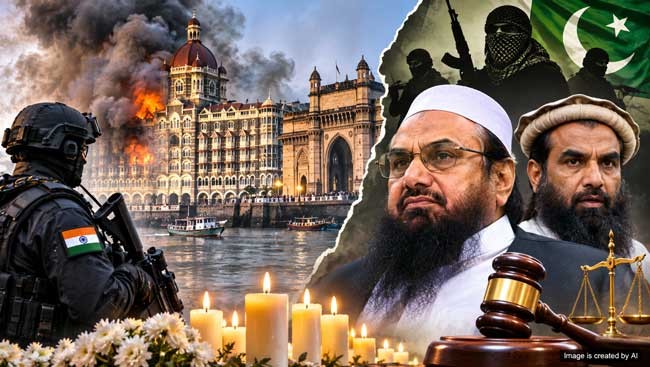
Desk: India marks the 18th anniversary of the horrific 26/11 Mumbai terror attacks on November 26, 2026. However, nearly two decades after the attacks, several key conspirators allegedly involved in planning and executing the assault have yet to face justice. According to Indian security agencies, six major accused, including Lashkar-e-Taiba (LeT) chief Hafiz Saeed and the terror group's operations commander Zaki-ur-Rehman Lakhvi, are believed to be in Pakistan and allegedly continue to remain active.
The attacks claimed 166 lives and targeted several prominent locations in Mumbai, including the Taj Mahal Palace Hotel, Oberoi-Trident Hotel, Chhatrapati Shivaji Maharaj Terminus and Nariman House. The nearly 60-hour-long terror operation shook the entire country and exposed serious security vulnerabilities.
Six Key 26/11 Conspirators Allegedly Based in Pakistan
According to Indian intelligence agencies, six prominent individuals allegedly involved in plotting the 26/11 attacks are Hafiz Saeed, Zaki-ur-Rehman Lakhvi, Sajid Majid alias Sajid Mir, Abdur Rehman Hashim Syed alias Pasha, Major Iqbal and Major Sameer Ali.
These individuals have been accused of playing significant roles in planning the attacks, directing the terrorists and coordinating the operation. Pasha is reportedly a retired major of the Pakistan Army, while Major Iqbal and Major Sameer Ali have been accused of having links with Pakistan's intelligence agency, the Inter-Services Intelligence (ISI).
Sentences Announced, But Questions Remain Over Their Detention
Pakistan announced action against some of the accused following international pressure. Hafiz Saeed was sentenced to a total of 78 years in prison in 2020 in connection with terror financing cases. However, Indian authorities have alleged that he continues to enjoy protection from Pakistan's intelligence establishment and has remained involved in activities linked to terrorism.
Similarly, Zaki-ur-Rehman Lakhvi was sentenced in 2021 to three separate five-year prison terms in terror financing cases. Indian agencies have questioned the effectiveness of the action taken against him.
Sajid Mir was reportedly arrested and sentenced to eight years in prison. However, his current whereabouts have not been clearly established in publicly available information. Questions have also been raised over the absence of effective action against the two alleged ISI-linked officers and the former military officer.
Seven of the Ten Key Conspirators Were in Pakistan
According to Indian security agencies, a total of ten major accused were identified in connection with the conspiracy behind the 26/11 attacks. Seven of them were reportedly present in Pakistan at the time of the assault.
Investigators have alleged that individuals based in Pakistan played a crucial role in planning the attacks, providing instructions to the terrorists and coordinating the operation through a control room.
Indian authorities had also sent Letters Rogatory to Pakistan, seeking evidence and information related to the accused. However, Indian officials have repeatedly expressed concerns over the lack of adequate cooperation from Islamabad. India's request for the extradition of Hafiz Saeed also remains unresolved.
Terrorists' Trainers and Handlers Also Allegedly Based in Pakistan
Apart from the six major accused, investigations into the Mumbai attacks identified several other individuals allegedly involved in preparing the attackers.
These included Abu Kafa, Abu Alqama, Muzzamil, Abu Anas and Abu Hamza.
They have been accused of training the ten terrorists who carried out the Mumbai attacks, teaching them how to use weapons and preparing them for the operation. According to Indian agencies, these individuals are also believed to be in Pakistan.
Two Other Conspirators Have Died
Two other individuals linked to the broader terror network are reported to have died.
Abdul Rehman Makki, former deputy chief of Lashkar-e-Taiba and brother-in-law of Hafiz Saeed, died in Lahore in December 2024.
Another prominent figure, Ilyas Kashmiri, a leader associated with Al-Qaeda and Pakistan-based Harkat-ul-Jihad-al-Islami, was reportedly killed in a US drone strike in June 2011.
David Headley and Tahawwur Rana: Indian Agencies Make Progress
Among those accused in connection with the 26/11 conspiracy, Indian investigative agencies have made significant progress in securing access to US citizen David Coleman Headley and Pakistani-Canadian national Tahawwur Rana.
The National Investigation Agency (NIA) questioned David Headley in 2011. However, the United States did not permit his extradition to India.
In a significant development, Tahawwur Rana was extradited from the United States to India in April 2025. He is currently lodged in Delhi's Tihar Jail.
Based on the investigation and questioning of Rana, a fresh chargesheet related to the 26/11 attacks was also filed in July 2025. Investigative documents alleged that Rana had been part of the conspiracy since 2006.
18 Years Later, Justice Remains Elusive
The November 26, 2008, Mumbai terror attacks claimed 166 innocent lives. Security forces eliminated nine terrorists, while the only terrorist captured alive, Ajmal Kasab, was sentenced to death after trial and hanged on November 21, 2012.
Eighteen years later, the alleged involvement of key conspirators who are believed to remain in Pakistan, and the absence of effective legal action against several of them, continue to raise serious questions.
While India continues to pursue accountability through diplomatic and legal channels, justice for the victims and their families remains an unfinished chapter in the country's fight against terrorism.
What's Your Reaction?
 Like
0
 Dislike
0
 Love
0
 Funny
0
 Wow
0
 Sad
0
 Angry
0

Writing has always come naturally to Aditya Tikku, who writes with enthusiasm. He became a published author as a result of his literary endeavors. Aditya Tikku, who was born into the family of Gauri and Surendra Nath Tikku, became passionate about social work as he grew older and utilized this as a means of helping other children with their education. He has also explored Prayagraj, Ujjain, and Nashik Kumbh.











Comments (0)