
Death Risk 62% Lower Among Men from Wealthiest Families in India, Study Reveals
A new study finds that men from India's wealthiest households face 62% lower mortality risk than those from the poorest families, highlighting the impact of economic status, caste and religion on adult survival.
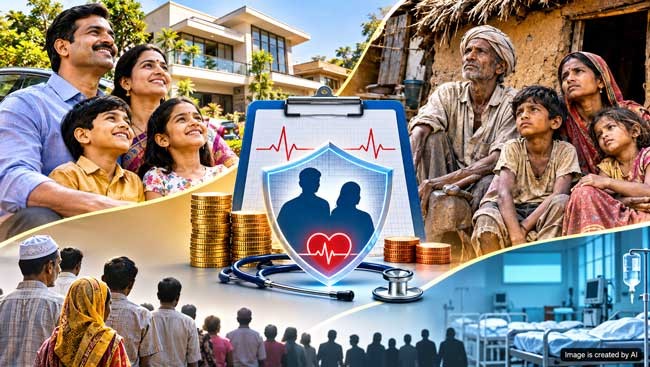
Desk: Economic status has a significant impact on life expectancy and the risk of premature death in India. A new study has found that men from the wealthiest households are 62% less likely to die between the ages of 15 and 59 than men from the poorest households. Among women, the difference stands at 42%.
The study also highlights significant differences in adult mortality risks across religious and caste groups, underlining the role of economic and social inequalities in determining survival chances.
Published in the reputed journal Demographic Research, the study was conducted by Mordhwaj Dhakad of the Max Planck Institute for Demographic Research and Nandita Saikia of the International Institute for Population Sciences (IIPS). The researchers analysed data from three rounds of the National Family Health Survey (NFHS), covering 1998-99, 2015-16 and 2019-21.
Poorer Households Face Higher Mortality Risk
According to the study, the probability of death between the ages of 15 and 59 was 280 per 1,000 men in the poorest households, compared with 158 per 1,000 men in the wealthiest households.
A similar pattern was observed among women. The mortality risk stood at 157 per 1,000 women in the poorest households, while it was 87 per 1,000 among women from the richest households.
The researchers also accounted for differences in caste, religion, rural and urban residence, and geographical location across states. Even after adjusting for these factors, economic status continued to have a strong association with mortality. Men belonging to the richest 20% of households had a 62% lower risk of death than those from the poorest 20%.
Muslim Men Have 21% Lower Mortality Risk Than Upper-Caste Hindu Men
The study also identified differences in adult mortality across religious and caste groups. According to the 2019-21 data, the probability of death per 1,000 men stood at 256 among Scheduled Caste men and 254 among Scheduled Tribe men. Among upper-caste Hindu men, the figure was 197.
One of the significant findings concerns Muslim men. Across all three survey rounds, Muslim men were found to have a lower adult mortality risk than upper-caste Hindu men. Even after accounting for economic status, place of residence and state-level differences, Muslim men had a 21% lower risk of death in 2019-21.
Researchers have pointed to possible explanations, including relatively lower alcohol consumption among Muslim adults and higher levels of urbanisation among Muslim populations in several states.
However, the same pattern was not observed among women. After accounting for economic and other factors, no significant difference was found in mortality risk between Muslim women and upper-caste Hindu women.
Scheduled Caste Women Face 19% Higher Mortality Risk
The research also highlights persistent inequalities among women. Even after adjusting for economic and geographical conditions, Scheduled Caste women were found to have a 19% higher mortality risk than upper-caste Hindu women.
The finding suggests that factors beyond household income, including social inequalities and disadvantages, may also influence health outcomes and survival chances.
Women's Mortality Risk Declined Faster Over Two Decades
The study also examined changes in adult mortality between 1998-99 and 2019-21. During this period, the probability of death among women aged 15 to 59 declined from 208 to 125 per 1,000, marking a reduction of approximately 40%.
Among men, the corresponding figure fell from 268 to 221 per 1,000, representing a decline of around 17%.
However, male mortality increased between the 2015-16 and 2019-21 survey periods. Researchers have identified additional deaths during the COVID-19 pandemic and occupational risks as possible factors behind this rise.
Equal Access to Healthcare Remains Essential
The study highlights how economic conditions and social inequalities shape survival outcomes in India. Its findings suggest that poverty affects not only living standards but also people's chances of surviving into middle age.
Reducing economic disparities, strengthening public healthcare infrastructure and ensuring equal access to quality medical services for disadvantaged communities remain crucial to addressing these inequalities.
What's Your Reaction?
 Like
0
 Dislike
0
 Love
0
 Funny
0
 Wow
0
 Sad
0
 Angry
0

Lili has been working in the field of digital journalism and content writing for the past 8 years. She possesses strong expertise in areas such as lifestyle, relationships, health, human interest, education, trending news, and feature stories. Her greatest strength lies in writing content in clear, accessible language that resonates directly with readers.










Comments (0)