Parliament Session Likely Before December 15, Delimitation Bill Back on Government Agenda
The Modi government is preparing for a Parliament session before December 15, with the delimitation-linked Women's Reservation Bill and political challenges likely to dominate the agenda.
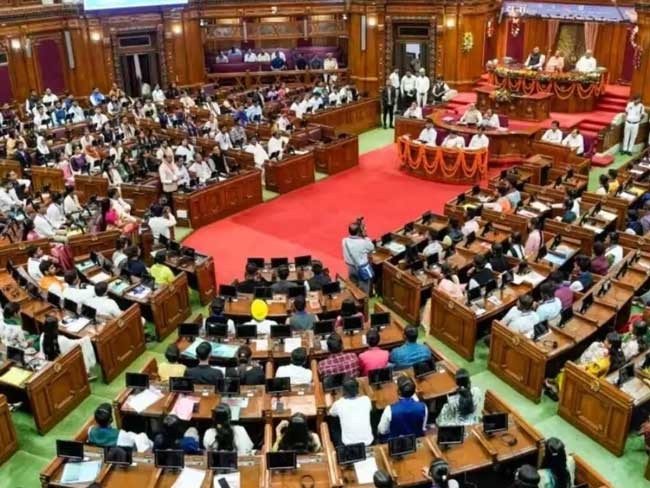
New Delhi: The Central Government has stepped up preparations for the upcoming parliamentary session and is considering another push for the Women's Reservation Bill linked to delimitation. Prime Minister Narendra Modi has reportedly instructed his Cabinet colleagues to complete all preparations for the session before December 15. Ministers have also been advised to avoid foreign visits during this period.
The issue was discussed during a Union Cabinet meeting chaired by Prime Minister Modi on Wednesday. According to sources, the government is considering convening Parliament before December 15. However, the final decision regarding the commencement and duration of the session will be taken by the Cabinet Committee on Parliamentary Affairs.
Monsoon Session Yet to Be Formally Concluded Even After 103 Days
The proceedings of Parliament's Monsoon Session were adjourned sine die on August 13. However, as of Wednesday night, the session had not been formally prorogued. This means that even after 103 days, the Monsoon Session had not officially come to an end.
The delay in convening the Winter Session has drawn criticism from opposition parties. Amid discussions over whether the existing session will be extended or a fresh session will be called, speculation about a special parliamentary session has also intensified.
Women's Reservation and Delimitation Likely to Be Key Priorities
The delimitation-linked Women's Reservation Bill could feature prominently on the government's agenda during the upcoming session. The proposed constitutional amendment aims to pave the way for implementing 33 per cent reservation for women in the Lok Sabha and state legislative assemblies.
However, securing its passage may prove challenging for the government. In the 543-member Lok Sabha, a constitutional amendment requires a two-thirds majority, which translates to 361 votes. With three seats currently vacant, the House has an effective strength of 540 members, while the ruling NDA is reported to have 320 MPs.
Consequently, the government will need additional support from opposition parties and other political groups to secure the required majority.
Changing Political Equations Raise Government's Hopes
The Bill failed to secure the necessary support in the Lok Sabha in April. However, political equations have changed since then.
According to reports, 26 MPs from the opposition camp have shifted political alignment. These include 20 Trinamool Congress MPs reportedly merging with the NCPI and six Shiv Sena (Uddhav Balasaheb Thackeray) MPs joining the Eknath Shinde-led Shiv Sena.
These developments are expected to improve the government's political position. Nevertheless, the NDA will still require support from other parties to reach the two-thirds majority mark.
In this political calculation, the DMK and the Nationalist Congress Party (Sharadchandra Pawar) are also considered important players.
Southern States' Concerns Over Delimitation Under Consideration
Concerns raised by southern Indian states over the proposed delimitation exercise remain a major challenge for the government. Several southern states fear that the exercise could disturb the existing balance of parliamentary representation among states.
To address these concerns, the government is reportedly considering a proposal to increase the number of Lok Sabha seats by up to 50 per cent across all states.
Another option under discussion is to maintain the existing proportion of parliamentary seats among states based on the 1971 Census. However, no final decision has been taken on these proposals so far.
SIR Issue May Trigger Opposition Protests in Parliament
The Special Intensive Revision (SIR) of electoral rolls is also likely to become a major point of confrontation during the upcoming parliamentary session.
Opposition parties have been opposing the exercise and have also demanded the resignation of Chief Election Commissioner Gyanesh Kumar.
Apart from delimitation and women's reservation, issues related to the electoral process could therefore lead to heated exchanges between the government and opposition.
The government's immediate challenge will be to ensure the smooth functioning of Parliament so that important legislative proposals can be discussed and put to vote.
All eyes are now on the official announcement of the next parliamentary session. If the government moves forward with the constitutional amendment linked to delimitation, the upcoming session could prove politically and constitutionally significant.
What's Your Reaction?
 Like
0
 Dislike
0
 Love
0
 Funny
0
 Wow
0
 Sad
0
 Angry
0

Ajay Gupta is a Senior Digital Content Producer at Prime Time India (PTI) Digital. He brings 19 years of experience, spanning both field reporting and desk-based editorial work. He began his journalistic career in 2006 with the Hindi newspaper Jansansar. He possesses extensive experience covering politics and crime, and has also worked on the central desk at Dainik Jagran, Nai Dunia, Haribhoomi. Furthermore, he has covered numerous elections from the ground. For the past six years, he has been working on the digital news desk at PTI (Prime Time India). He also has a strong grasp of Google Trends and podcasts.






Comments (0)