
Centre Approves 50% Increase in Lok Sabha Seats; House Strength May Rise to 816
The Union Cabinet approves a proposal to increase Lok Sabha seats by 50%, potentially expanding the House from 543 to 816 members, ahead of the proposed delimitation exercise and women's reservation implementation.
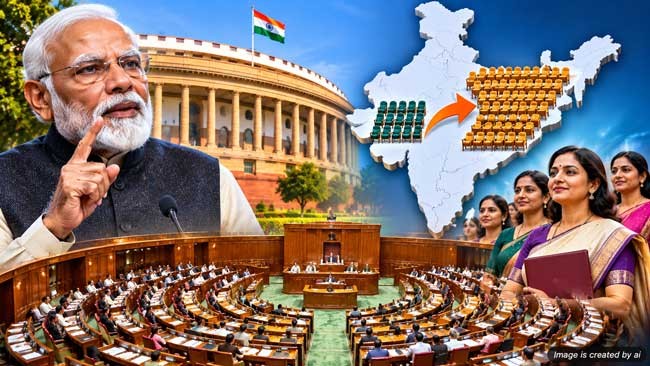
New Delhi: The Union Cabinet, chaired by Prime Minister Narendra Modi, has approved a significant proposal aimed at expanding India's parliamentary representation. Under the proposal, the number of Lok Sabha seats in all states could increase by up to 50 per cent. The move is being linked to the upcoming delimitation exercise and the implementation of the Women's Reservation Act.
According to the proposal, the strength of the Lok Sabha could increase from the existing 543 elected seats to approximately 816. The government's objective is to expand parliamentary representation while maintaining the existing proportion of seats allocated to different states. Reports suggest that the proposed arrangement may remain in place until 2051.
The Cabinet's approval comes ahead of the special session of Parliament scheduled to begin on November 30. The government is expected to consider constitutional amendments and other legislative proposals related to delimitation and women's reservation during the session.
Proposal to Increase Lok Sabha Seats by 50% Across All States
Under the proposed arrangement, the number of Lok Sabha seats in every state would increase by 50 per cent. The objective is to provide additional parliamentary representation to all states rather than allowing any particular state to gain a disproportionate political advantage.
One of the key aspects of the proposal is the protection of the existing proportion of seats among states. Southern states, in particular, have expressed concerns that a population-based delimitation exercise could reduce their relative representation in Parliament.
The government's proposed formula is being viewed as an attempt to address these concerns and ensure a more balanced distribution of parliamentary representation.
What Is Delimitation and Why Is It Important?
Delimitation refers to the process of redrawing the boundaries of parliamentary and assembly constituencies and determining their representation based on population.
The primary objective is to ensure fair representation of voters across constituencies. However, delimitation has remained a politically and constitutionally sensitive issue in India.
Several southern states have made significant progress in population control. These states fear that if parliamentary seats are redistributed solely on the basis of current population figures, their proportional representation in the Lok Sabha could be adversely affected.
The proposed 50 per cent increase in Lok Sabha seats is being seen as a possible solution to address this concern while allowing the delimitation process to move forward.
Women's Reservation Act: Proposal May Accelerate Implementation
Another major objective behind the proposed changes is to facilitate the implementation of 33 per cent reservation for women in Parliament and state legislative assemblies.
In 2023, Parliament passed the 106th Constitutional Amendment, popularly known as the Nari Shakti Vandan Adhiniyam. The legislation provides for reserving one-third of the seats in the Lok Sabha and state legislative assemblies for women.
However, its implementation was linked to the completion of a census and the subsequent delimitation exercise.
The government is now reportedly looking to accelerate the process so that the framework for implementing women's reservation can be put in place before the 2029 Lok Sabha elections.
Special Parliament Session to Begin on November 30
Following the Cabinet's approval, attention has shifted to the upcoming special session of Parliament.
According to Parliamentary Affairs Minister Kiren Rijiju, the Lok Sabha is scheduled to meet from November 30, while proceedings in the Rajya Sabha are expected to begin on December 2. The session may continue until December 3.
During the session, the government may introduce proposals related to delimitation, constitutional amendments and the implementation of women's reservation.
Securing a Two-Thirds Majority Could Be a Major Challenge for NDA
Passing the proposed constitutional amendments may not be an easy task for the Central Government.
Under Article 368 of the Constitution, a constitutional amendment bill must be passed separately by both Houses of Parliament through a special majority.
This requires a majority of the total membership of each House, along with the support of at least two-thirds of the members present and voting.
The government's earlier legislative attempt related to this issue reportedly failed to secure the required support in the Lok Sabha in April 2026.
Consequently, the NDA will once again face the challenge of securing support from opposition parties and regional political formations to move the proposed changes forward.
Major Implications for India's Political and Parliamentary System
The proposed 50 per cent increase in Lok Sabha seats could bring significant changes to India's democratic and parliamentary framework.
If the necessary constitutional amendments are passed by Parliament, the expansion could increase the overall strength of the Lok Sabha, provide additional representation to states and help accelerate the implementation of women's reservation.
However, it is important to note that the proposal has received Cabinet approval and has not yet become law. Its implementation will require parliamentary approval and the completion of the necessary constitutional procedures.
Therefore, the special session of Parliament beginning November 30 is expected to be crucial, not only for the government but also for the future political and parliamentary structure of the country.
What's Your Reaction?
 Like
0
 Dislike
0
 Love
0
 Funny
0
 Wow
0
 Sad
0
 Angry
0

Writing has always come naturally to Aditya Tikku, who writes with enthusiasm. He became a published author as a result of his literary endeavors. Aditya Tikku, who was born into the family of Gauri and Surendra Nath Tikku, became passionate about social work as he grew older and utilized this as a means of helping other children with their education. He has also explored Prayagraj, Ujjain, and Nashik Kumbh.







Comments (0)