
Trump’s 25% Tariff on India: 5 Strategies That Could Protect Indian Businesses and Exports
India is exploring five strategies to counter Trump's proposed 25% tariff, including market diversification, stronger manufacturing, trade negotiations and new global partnerships to protect exports and businesses.
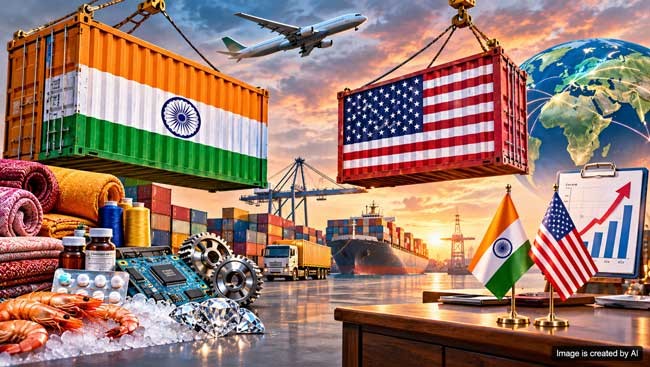
Business Desk: The trade relationship between India and the United States is facing fresh uncertainty after the Donald Trump administration proposed imposing tariffs of up to 25% on Indian goods. Washington has indicated that the proposed rate could be reduced to 17% if India and the US reach a bilateral trade agreement. The development has raised concerns among Indian exporters and businesses, particularly those dependent on the American market.
However, the proposed tariffs could also create an opportunity for India to reassess its global trade strategy, strengthen domestic manufacturing and explore new international markets.
Why Has the US Proposed a 25% Tariff on India?
The US administration has raised concerns about what it describes as structural excess manufacturing capacity in India. The investigation conducted under Section 301 of the US Trade Act examines industrial policies, market access restrictions, labour protections and other trade-related practices.
India, however, has challenged these allegations, maintaining that its manufacturing initiatives, including Make in India and the Production Linked Incentive (PLI) scheme, are designed to strengthen domestic production and reduce dependence on foreign supply chains.
The proposed 25% tariff is not yet a final decision. The US has also indicated that a trade agreement could bring the proposed rate down to 17%, making negotiations particularly important for Indian businesses.
Five Ways India Can Respond to Trump's Tariff Pressure
1. Explore New International Markets
India can reduce its dependence on the American market by expanding exports to Europe, Africa, Southeast Asia, Latin America and the Middle East. Stronger trade relationships with these regions could help Indian companies maintain business growth even if exports to the US become more expensive.
2. Strengthen Domestic Manufacturing
The government can provide additional support to domestic manufacturers through infrastructure development, improved logistics, technology investment and easier access to finance. A stronger manufacturing ecosystem would improve the global competitiveness of Indian products.
3. Negotiate Trade Agreements on Equal Terms
India can continue negotiations with Washington while protecting its economic interests. Any agreement should offer meaningful market access for Indian businesses rather than forcing one-sided concessions. A balanced agreement could benefit exporters as well as consumers in both countries.
4. Diversify Export Categories
Indian businesses should focus on developing new export categories and strengthening their position in existing sectors. Pharmaceuticals, engineering goods, electronics, textiles, chemicals and agricultural products can play important roles in India's long-term export strategy, subject to applicable tariff exemptions and sector-specific duties.
5. Strengthen Trade Partnerships and Economic Cooperation
India can deepen economic cooperation with countries and regional trade groups through new partnerships, investment agreements and supply-chain collaborations. Stronger international relationships would provide Indian companies with alternative markets and reduce the impact of sudden trade restrictions.
Which Indian Industries Could Face the Biggest Impact?
The proposed tariffs could create challenges for several labour-intensive and export-oriented industries. Textiles, apparel, gems and jewellery, seafood, chemicals and certain engineering products are among the sectors that could face pressure.
According to a Business Standard report published on November 26, 2026, India's textile exports to the US declined 25.2% to $3.1 billion during January-September 2026, compared with approximately $4.14 billion in the corresponding period of 2025. Exporters have also reported some improvement in order flows since October.
At the same time, pharmaceuticals and smartphones are among the major Indian export categories that have exemptions under the proposed tariff framework. Certain products, including steel, aluminium and automobiles, are governed by separate sector-specific tariff arrangements.
Can Trump’s Tariff Strategy Backfire on the US?
Higher import duties may make Indian products more expensive for American importers and consumers. US businesses that depend on Indian suppliers could also face higher sourcing costs or disruptions in their supply chains.
India is an important trading partner for the US, particularly in pharmaceuticals, information technology, textiles, engineering and several manufacturing segments. If trade becomes more expensive, American companies may also have to reconsider their sourcing strategies.
This is where the tariff strategy could become challenging for Washington. While higher duties may put pressure on Indian exporters, they could also increase costs for American businesses and consumers.
What Lies Ahead for India-US Trade Relations?
The proposed tariff structure has brought the ongoing India-US trade negotiations back into focus. The possibility of reducing the proposed rate from 25% to 17% offers some room for diplomatic and commercial negotiations.
For India, the challenge is to protect its export interests without compromising its long-term manufacturing ambitions. Diversifying markets, improving product competitiveness and strengthening domestic industries could prove more sustainable than relying exclusively on any single international market.
The coming months will be important for Indian exporters as the US reviews the proposal and both countries continue discussions on a possible trade agreement. The larger question is whether tariff pressure will lead to a mutually beneficial trade arrangement or encourage India to accelerate its search for alternative global markets.
What's Your Reaction?
 Like
0
 Dislike
0
 Love
0
 Funny
0
 Wow
0
 Sad
0
 Angry
0

Ajay Gupta is a Senior Digital Content Producer at Prime Time India (PTI) Digital. He brings 19 years of experience, spanning both field reporting and desk-based editorial work. He began his journalistic career in 2006 with the Hindi newspaper Jansansar. He possesses extensive experience covering politics and crime, and has also worked on the central desk at Dainik Jagran, Nai Dunia, Haribhoomi. Furthermore, he has covered numerous elections from the ground. For the past six years, he has been working on the digital news desk at PTI (Prime Time India). He also has a strong grasp of Google Trends and podcasts.











Comments (0)