
Kiren Rijiju Asks Rahul Gandhi 4 Questions, Raises 1962 China War and Poverty
Union Minister Kiren Rijiju targets Rahul Gandhi with four questions on the 1962 China war, India's poverty, the snake-charmer image and the Hindu rate of growth.
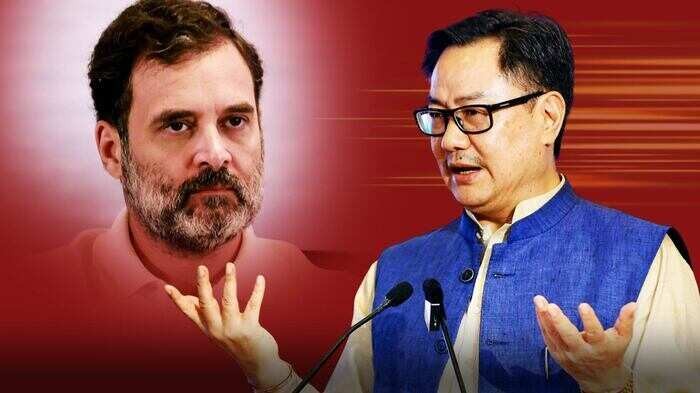
New Delhi: Union Parliamentary Affairs Minister Kiren Rijiju has launched a fresh political attack on Congress leader Rahul Gandhi, raising four questions over his recent remarks targeting Prime Minister Narendra Modi as a "compromised Prime Minister".
Rijiju's questions focus on the 1962 India-China war, India's poverty during Congress rule, the country's historical international image and the term 'Hindu rate of growth' used to describe India's slow economic expansion in the decades after Independence.
The minister's remarks have added another chapter to the ongoing political confrontation between the BJP and Congress over India's foreign policy, economic record and political leadership.
Rijiju Targets Rahul Gandhi Over the 1962 China War
One of Rijiju's central questions concerns the 1962 India-China war and the territorial losses suffered by India during the conflict.
Referring to his ancestral village in Arunachal Pradesh, Rijiju asked whether Congress would apologise for what he described as the national humiliation of 1962.
"China occupied my village in 1962. Will Congress apologise for the humiliation of 1962?" was the question raised by the Union Minister.
Rijiju's ancestral village, Nakhu, is located in the Kameng region of Arunachal Pradesh, an area affected by Chinese military operations during the 1962 war.
The region, then known as the North-East Frontier Agency (NEFA), witnessed Chinese military advances during the conflict. Chinese forces entered several areas, including parts of the Tawang region, before Beijing announced a unilateral ceasefire.
Rijiju has repeatedly raised concerns over China's actions in the region and alleged that areas connected to his ancestral village were among those affected by the Chinese advance.
India's Poverty During Congress Rule Becomes Another Point of Attack
Rijiju's criticism also focused on India's economic condition during the decades when Congress dominated national politics.
The Congress party made the slogan 'Garibi Hatao' (Remove Poverty) its central political message during the 1971 general election under Prime Minister Indira Gandhi.
The slogan was introduced as a political response to the opposition's 'Indira Hatao' campaign and became a major part of Congress's electoral strategy. The party subsequently incorporated poverty reduction into its development agenda.
However, the political debate over India's poverty record has continued.
The Rangarajan Committee's estimates, released in June 2014, indicated that approximately 36.3 crore people in India were living below the poverty line in 2011-12, during the Congress-led UPA government's tenure.
On the other hand, a recent World Bank report cited in the political debate suggests that nearly 50 crore people moved out of poverty between 2011 and 2023.
The BJP has used these figures to question Congress's economic record and challenge Rahul Gandhi's criticism of the present government.
Nehru and the Controversy Over India's 'Land of Snake Charmers' Image
Another issue raised in the political debate concerns India's international image during the early decades after Independence.
The BJP has frequently accused Congress leaders of failing to adequately promote India's civilisational heritage and cultural strengths internationally.
Prime Minister Narendra Modi and other BJP leaders have previously criticised the portrayal of India as a land of snake charmers, arguing that such representations failed to reflect the country's scientific, cultural and intellectual achievements.
On February 23 this year, BJP leader Amit Malviya referred to an episode involving former Prime Minister Jawaharlal Nehru and an Air India promotional pamphlet.
According to Malviya's post on X, Nehru was questioned in 1955 about why an Air India pamphlet portrayed India as a land of snake charmers.
Malviya claimed that Nehru defended the portrayal, reportedly arguing that there was nothing wrong with it because it appealed to tourists.
The controversy has once again become part of the BJP's broader criticism of the Congress's approach to India's cultural identity and international representation.
Who Coined the Term 'Hindu Rate of Growth'?
Rijiju's fourth line of attack concerns the phrase 'Hindu rate of growth', which was used to describe India's relatively slow economic growth between the 1950s and 1980s.
During this period, India's annual economic growth rate remained around 3.5% for several decades.
According to Arthapedia, the expression was first used by Professor Raj Krishna, a member of the Planning Commission.
The term became widely associated with the slow pace of economic expansion during the decades following Independence.
The BJP has referred to this period while questioning the Congress's economic policies and its record of managing India's growth.
What Did Rahul Gandhi Say About PM Modi?
The latest political exchange began after Rahul Gandhi shared a photograph of a meeting involving US President Donald Trump, Russian President Vladimir Putin and Chinese President Xi Jinping.
The photograph was associated with the APEC summit setting in Shenzhen, a city in southern China.
In his social media post on Friday, Gandhi took a swipe at the BJP government, suggesting that if Congress were in power, India's Prime Minister would also have been present at the table with the three global leaders.
He also repeated his description of Prime Minister Narendra Modi as a "compromised PM".
Rijiju responded by raising questions about Congress's own record on national security, economic development and India's international standing.
The exchange highlights the continuing political battle between the BJP and Congress over foreign policy, the legacy of previous governments and India's position in the changing global order.
What's Your Reaction?
 Like
0
 Dislike
0
 Love
0
 Funny
0
 Wow
0
 Sad
0
 Angry
0

Vivek Awasthi is a Digital Content Producer at Prime Time India (English). He joined in March 2025. As a member of the news team, he is responsible for editing and curating national news, as well as stories concerning Delhi and crime. He also engages in field reporting from time to time; Vivek has a keen interest in going out into the field to uncover the stories behind the news.







Comments (0)