
British Swimmer Lewis Pugh Crosses Strait of Hormuz in Three Days, Witnesses Ship Attacks
British endurance swimmer Lewis Pugh crossed the Strait of Hormuz in three days, witnessing ship attacks and warning of long-term environmental damage to marine life.
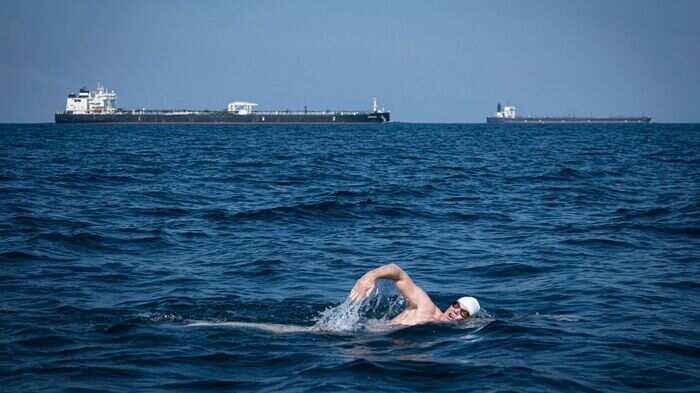
New Delhi: British endurance swimmer Lewis Pugh has completed a challenging swim across the Strait of Hormuz amid the ongoing conflict involving Iran, the United States and Israel. The 56-year-old swimmer covered approximately 15 kilometres between the Musandam Peninsula and the Cape of Hormuz over three days, drawing attention to the environmental consequences of the conflict.
Pugh is believed to be the first person to undertake a long-distance swim in this strategically important waterway since the war began. Wearing only swimming trunks, goggles and a cap bearing the United Nations logo, he spent a total of around six and a half hours in the water during the three-day challenge.
After returning to London, Pugh described witnessing explosions, attacks on commercial vessels and the immediate dangers facing ships in the region.
Explosions and Ship Attacks During the Swim
Pugh said that shortly after entering the water on Monday, November 16, he heard two powerful explosions. He later saw that an oil tanker approximately four kilometres away had come under attack.
Fighter aircraft subsequently passed over the area, forcing his support team to move away from the location for safety reasons.
The swimmer also had to pass near another vessel that had reportedly caught fire following an attack. On the second day, while returning towards the port, he witnessed an attack on a gas carrier. A strong smell spread through the surrounding area, while flames were visible in the water around the vessel.
Despite several interruptions and the dangerous conditions, Pugh eventually completed his swim.
Marine Life and Coral Reefs Face Serious Threats
Pugh said the Strait of Hormuz is often viewed primarily as a major international shipping route, but it is also an important natural ecosystem.
He warned that oil leaking from dozens of damaged tankers since the conflict began in February could have serious consequences for marine life and coastal habitats. Dolphins, turtles, coral reefs and mangrove forests could face damage lasting for years, he cautioned.
According to Pugh, cleaning up oil once it spreads through sensitive marine environments can be extremely difficult.
During his journey, he also spotted large groups of dolphins swimming behind his support boat, along with turtles and seabirds. These encounters highlighted the rich marine biodiversity that could be threatened by continued pollution and attacks on vessels.
The Strategic Battle Over the Strait of Hormuz
Before the conflict began on February 28, approximately one-fifth of the world's oil trade passed through the Strait of Hormuz, making it one of the most important energy shipping routes in the world.
In recent weeks, tensions around the waterway have intensified. According to the account, Iran has increased attacks on vessels attempting to pass through unauthorised routes, while several tankers have reportedly caught fire after encountering naval mines.
The growing security crisis has raised concerns not only about global energy supplies but also about the long-term environmental impact of damage to commercial ships and oil and gas infrastructure.
Lewis Pugh's Message Through 'Speedo Diplomacy'
For nearly four decades, Lewis Pugh has used long-distance swimming to draw attention to ocean conservation. His swims have taken him from Antarctica and the North Pole to the Red Sea and other environmentally significant locations.
His approach to using sporting challenges as a means of encouraging dialogue and raising awareness is often described as 'Speedo Diplomacy'.
Through his latest challenge in the Strait of Hormuz, Pugh sought to highlight the environmental cost of war. He called for an end to the conflict, the reopening of the strategic waterway and efforts to clean up pollution in the surrounding waters.
In a message shared on his website, Pugh warned that attacks on oil tankers, gas carriers and other commercial vessels could leave environmental consequences that last for generations.
His swim has brought renewed attention to a crisis that extends beyond military confrontation and global trade, raising questions about the protection of marine ecosystems during armed conflicts.
What's Your Reaction?
 Like
0
 Dislike
0
 Love
0
 Funny
0
 Wow
0
 Sad
0
 Angry
0

Jaspreet Walia is a digital content producer at Prime Time India. He has 6 years of experience in journalism and covers international affairs (world section). He began his digital career with Amar Ujala, subsequently worked with Surbhi Saloni Hindi and Patrika, and is now with Prime Time India. He completed his education at Chaudhary Charan Singh University and the Indian Institute of Mass Communication.















Comments (0)