
Good or Bad? Policy Decisions Can Only Be Judged After Decades, Says General Naravane
Former Army Chief General Naravane says the true impact of major policy decisions can only be assessed over decades, not immediately after their implementation.
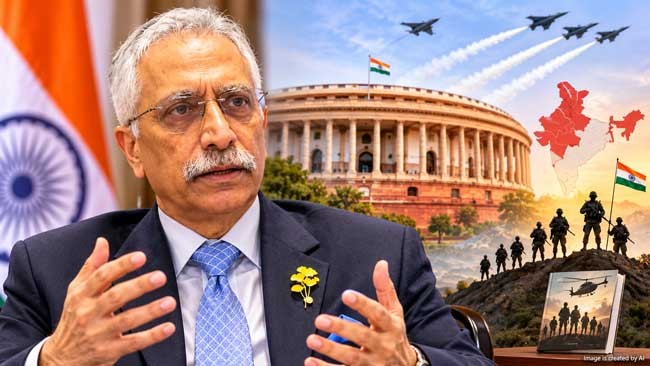
Pune: Former Chief of the Army Staff General Manoj Mukund Naravane (Retd.) has said that the real impact of major policy decisions can only be assessed over a long period, adding that it is difficult to determine whether a decision is good or bad immediately after its implementation.
Speaking to ANI in Pune on Saturday, General Naravane said that the actual value of a policy becomes evident after 10, 15 or even 20 years. He was responding to a question about major policy decisions, including the proposed implementation of the Delimitation Bill.
"With any decision, it is very difficult to say right away whether it is a good decision or a bad one. You only come to know the true value of that decision after 10, 15, or 20 years," he said.
Delimitation Bill Ahead of Parliament Session
His remarks come ahead of the upcoming Parliament session, scheduled from November 30 to December 4, during which the Delimitation (Second) Bill, 2026, is expected to be taken up for debate and consideration.
The proposed delimitation exercise has become an important political issue, with discussions surrounding its possible implications for parliamentary representation and the country's political landscape.
The Centre's efforts to secure the required two-thirds majority for the proposed Constitution Amendment Bill received a boost after the DMK, YSRCP and NCP-SP indicated support for the revised proposals. This reportedly took the NDA's estimated strength in the Lok Sabha to 354 MPs.
Naravane on China-Pakistan Strategic Partnership
During the interaction, the former Army chief also spoke about the strategic relationship between China and Pakistan, particularly in the context of military cooperation during Operation Sindoor.
He said India does not need external validation, including from the United States, to understand the close strategic relationship between the two countries.
According to Naravane, India has long been aware of the economic and military ties between China and Pakistan and has consistently factored these realities into its defence planning, policies and strategic preparations.
He maintained that the relationship between the two countries was neither unexpected nor a new development for India's security establishment.
From Soldier to Storyteller
General Naravane also spoke about his non-fiction book, The Curious and the Classified: Unearthing Military Myths and Mysteries.
The book brings together 25 lesser-known stories and anecdotes from the Indian Army, Navy and Air Force, offering readers insights into military life and experiences that rarely reach the wider public.
Explaining the objective behind writing the book, he said that such stories deserve to be told as they can help strengthen the connection between the armed forces and ordinary citizens.
Naravane expressed satisfaction with the response to his book and described his transition from military service to writing as a new chapter in his life, saying that he had moved from being a soldier to becoming a storyteller.
His remarks covered three significant areas — the long-term consequences of policy decisions, India's understanding of regional security challenges and the importance of bringing the experiences of the armed forces closer to the civilian population.
What's Your Reaction?
 Like
0
 Dislike
0
 Love
0
 Funny
0
 Wow
0
 Sad
0
 Angry
0

Ajay Gupta is a Senior Digital Content Producer at Prime Time India (PTI) Digital. He brings 19 years of experience, spanning both field reporting and desk-based editorial work. He began his journalistic career in 2006 with the Hindi newspaper Jansansar. He possesses extensive experience covering politics and crime, and has also worked on the central desk at Dainik Jagran, Nai Dunia, Haribhoomi. Furthermore, he has covered numerous elections from the ground. For the past six years, he has been working on the digital news desk at PTI (Prime Time India). He also has a strong grasp of Google Trends and podcasts.









Comments (0)