
Netanyahu Eyes Power-Sharing Deal with Gadi Eisenkot to Break Israel’s Political Deadlock
Netanyahu is reportedly considering a power-sharing deal with opposition leader Gadi Eisenkot, offering a rotating prime minister arrangement to overcome Israel’s political deadlock and form a new government.
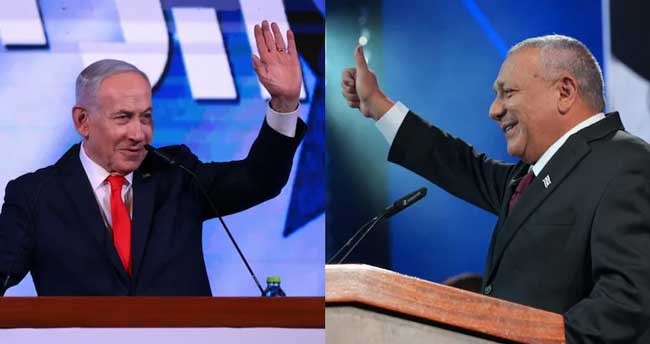
Desk: Amid the ongoing political deadlock over the formation of a new government in Israel, Prime Minister Benjamin Netanyahu is reportedly considering a major political move. According to media reports, Netanyahu may offer opposition leader Gadi Eisenkot a power-sharing arrangement under which the two leaders would rotate as prime minister. Under the proposed arrangement, Eisenkot could serve as prime minister first, with Netanyahu taking over the position at a later stage.
According to The Times of Israel, Netanyahu is preparing to publicly signal his willingness to consider such a power-sharing arrangement. However, the proposal has reportedly triggered disagreements within the Prime Minister’s Office. Citing Israel’s Channel 13, reports suggest that efforts are being made to communicate the proposal to Eisenkot through unofficial channels.
Divisions Within Netanyahu’s Likud Party
According to reports, there is no consensus within Netanyahu’s ruling Likud Party over the possibility of a power-sharing agreement. While some party leaders may be open to sharing power, others are reportedly concerned about the political consequences of such an arrangement.
Meanwhile, former military chief and Yashar Party leader Gadi Eisenkot is said to be sceptical about Netanyahu’s proposal. He is also continuing preparations to form a government of his own next week.
Eisenkot has reportedly assured his coalition partners, Yair Golan and Avigdor Lieberman, that no unity government with Likud will be formed without their consent.
61 Seats Required to Form Government
Israel’s 120-member parliament, the Knesset, requires a minimum of 61 seats to form a government. Under the current political calculations, Eisenkot’s coalition remains well short of the required majority.
Eisenkot’s Yashar Party, Yair Golan’s Democrats Party and Lieberman’s Yisrael Beiteinu Party together hold 36 seats. With the support of former Israeli Prime Minister Naftali Bennett’s Beyachad Party, the coalition’s strength would increase to 48 seats.
This leaves Eisenkot with the challenge of securing additional support from Netanyahu’s Likud Party, ultra-Orthodox Jewish parties or Arab-backed political groups to reach the required majority.
Eisenkot Has Until December 6 to Form Government
Israeli President Isaac Herzog has given Eisenkot 28 days to form a government. The deadline is set to expire on December 6, leaving him with limited time to secure the necessary political support.
Meanwhile, the Arab-majority Ra'am Party has also reportedly offered to support an Eisenkot-led government. According to reports, the party has sought representation in the Cabinet and substantial investments for the development of Arab communities in exchange for supporting the government on security-related decisions.
Could Israel See Another Rotational Government?
Israel has previously experimented with rotational prime ministerial arrangements. Under
What's Your Reaction?
 Like
0
 Dislike
0
 Love
0
 Funny
0
 Wow
0
 Sad
0
 Angry
0

Ajay Gupta is a Senior Digital Content Producer at Prime Time India (PTI) Digital. He brings 19 years of experience, spanning both field reporting and desk-based editorial work. He began his journalistic career in 2006 with the Hindi newspaper Jansansar. He possesses extensive experience covering politics and crime, and has also worked on the central desk at Dainik Jagran, Nai Dunia, Haribhoomi. Furthermore, he has covered numerous elections from the ground. For the past six years, he has been working on the digital news desk at PTI (Prime Time India). He also has a strong grasp of Google Trends and podcasts.














Comments (0)