
India Must Accelerate Military Space Programme Amid China-Pakistan Cooperation: CDS
India must accelerate its military space programme as China-Pakistan space cooperation raises strategic security concerns, says Chief of Defence Staff General N. S. Raja Subramani.
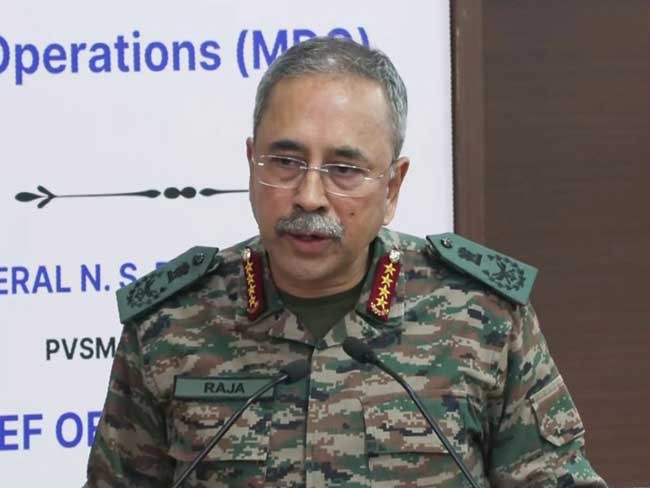
New Delhi: Chief of Defence Staff (CDS) General N. S. Raja Subramani has described the growing space cooperation between China and Pakistan as a significant strategic challenge for India's national security. He emphasised that India must take Pakistan's expanding space capabilities and the technological assistance it receives from China into account while formulating its military strategies. He also stressed the need to accelerate India's military space programme.
Addressing an event titled 'Future of Warfare and India's Preparedness to Conduct Multi-Domain Operations (MDO)' at the Vivekananda International Foundation (VIF), General Subramani said that Pakistan's space capabilities were steadily improving with China's support. He noted that Pakistan's national space agency, SUPARCO, was also working towards developing indigenous capabilities.
The CDS further expressed concerns that Pakistan could receive additional assistance from Turkey in this domain. According to him, Pakistan could gain greater access to China's space-based Intelligence, Surveillance and Reconnaissance (ISR) capabilities, along with Positioning, Navigation and Timing (PNT) services.
Such developments could significantly enhance Pakistan's surveillance capabilities and its ability to gather military intelligence.
SBS-3 to Strengthen India's Space Surveillance Capabilities
General Subramani said that India was also moving rapidly to strengthen its space-based military capabilities. In this regard, the third phase of the Space-Based Surveillance (SBS-3) project is expected to play a crucial role in enhancing India's space surveillance and strategic capabilities.
He highlighted that India was working towards developing the capacity to manufacture and launch a larger number of satellites. The government is also encouraging participation from private-sector enterprises to accelerate the development of the country's space infrastructure and meet growing strategic requirements.
The expansion of satellite-based surveillance is expected to become increasingly important as modern warfare relies more heavily on real-time intelligence, communication and navigation systems.
India Plans Changes in Defence Acquisition Process
The CDS identified the speed of decision-making and implementation as one of the major challenges facing India's defence modernisation efforts. He said that the country had sufficient resources to move ahead of Pakistan and reduce the capability gap with China, provided that defence procurement and development processes were made faster and more efficient.
He revealed that a comprehensive proposal to reform the Defence Acquisition Process had already been submitted to the Prime Minister's Office (PMO). He expressed hope that the necessary amendments would be introduced by early next year.
General Subramani underlined that India's objective should not simply be to match Pakistan's military capabilities but to move ahead of them. At the same time, reducing the existing military capability gap with China remains an important strategic priority.
Space Technology Emerging as a Key Element of Future Warfare
The CDS's remarks highlight the growing importance of space-based surveillance, navigation and intelligence in modern military operations. With China and Pakistan expanding their cooperation in space technology, India is looking to strengthen its own capabilities through advanced satellite systems, greater private-sector participation and faster defence procurement mechanisms.
As warfare increasingly moves towards multi-domain operations, developing a robust military space infrastructure is likely to remain a key component of India's long-term national security strategy.
What's Your Reaction?
 Like
0
 Dislike
0
 Love
0
 Funny
0
 Wow
0
 Sad
0
 Angry
0
Writing has always come naturally to Aditya Tikku, who writes with enthusiasm. He became a published author as a result of his literary endeavors. Aditya Tikku, who was born into the family of Gauri and Surendra Nath Tikku, became passionate about social work as he grew older and utilized this as a means of helping other children with their education. He has also explored Prayagraj, Ujjain, and Nashik Kumbh.












Comments (0)